Building the Face and Presence of Health Care AI with Nuance Labs
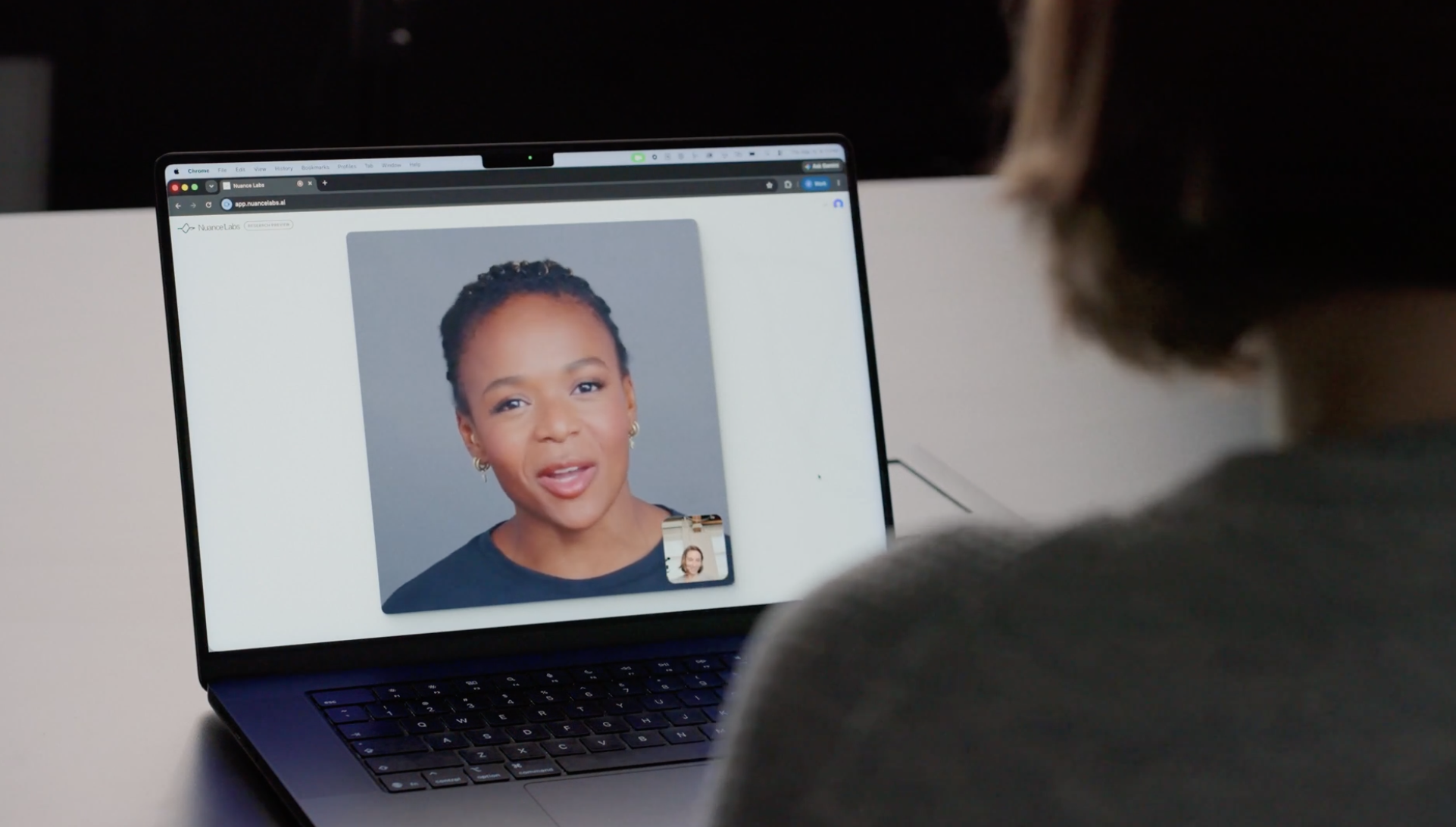
Today, we're proud to back Nuance Labs' $50M Series A alongside Lightspeed, Accel, South Park Commons, and NVIDIA. Nuance Labs is building a frontier foundation model for how people and AI communicate in any setting where that conversation carries weight. We are backing them for what it will mean in health care.
AI is moving into clinical and patient-facing work fast, and most of it still talks like a form. Patients notice. A tool that can't read frustration, confusion, or relief will never carry the conversations that matter in care. We believe every patient interaction gets better with more emotional intelligence in it, and that is the bet we're making with Nuance Labs.
Nuance Labs' full-duplex model takes in audio and visual input at the same time, so its avatars read a person's voice and body language while they speak and answer with emotion that feels authentic and human, not scripted. For health care organizations, that means an interface patients will actually engage with, and a better front end for the AI extenders they are already deploying.
The Challenge: There Aren't Enough Clinicians, and Text Can't Carry the Conversation
At a time when the United States is running short of physicians, we believe AI can widen access to care and raise its quality.
HRSA, the Health Resources and Services Administration within HHS, projects a shortfall of up to 141,160 FTE physicians by 2038. Patients already feel it. Across 15 of the largest U.S. metro areas, a new patient now waits an average of 31 days for a physician appointment, up 19% since 2022 and 48% since 2004 (AMN Healthcare). Those metros have some of the highest physician-to-population ratios in the country. If patients in the best-staffed cities wait a month, the national picture is likely worse. AI is starting to prove its place in widening access to care. In the clinic, it has taken administrative work off providers and handed back time for patients. It is getting better at the clinical work itself, and the demand for AI is rising:
The models now beat the benchmarks. In a 2026 Science study, Buckley and colleagues tested many of the large LLMs and found they surpassed existing benchmarks for clinical reasoning.
Patients are already asking. Rock Health found that 32% of consumers turned to consumer AI for health information in 2025, double the share in 2024.
Health systems want it at the front door. In our AI for Payers and Providers Report, 43% of providers and 69% of payers ranked the call center a top-three use case for AI.
Most large language models are still text-first, which ties the interaction to a keyboard. Voice AI opened a second medium, and health care moved on it quickly. Providers now use voice agents to take on patient needs and questions, from scheduling appointments to checking in on conditions. The front door of health care is becoming an AI conversation.
Nuance Labs' Solution: An AI That Understands, Sees, and Hears
Empathy and presence in a provider are tied to better clinical outcomes and better patient experiences.1 As AI becomes an extension of health care organizations and speaks with patients directly, the experience has to be as genuine as the intentions of the organizations deploying it. Health care has already embraced telemedicine and virtual video visits, but AI has not kept up. Most platforms offering human-like interaction still sit on the wrong side of the uncanny valley, and an experience that feels artificial cannot be experienced as sincere.
Nuance Labs is closing that gap. The team took a different architectural approach to the model itself, one that supports real-time, responsive interaction people find natural to engage with, and that can carry the qualities patients recognize in the most caring and effective providers.
Why Now and Why This Team?
This is a team with a rare blend of technical depth, product taste, and conviction. Fangchang Ma, CEO, holds a PhD in robotics and machine learning from MIT. Edward Zhang, CTO, holds a PhD in computer graphics from the University of Washington. Karren Yang, Chief Scientist, holds a PhD in audiovisual synthesis from MIT. The trio previously shipped consumer products at Apple, working on how machines perceive and reconstruct people. Frontier researchers who have built for hundreds of millions of users are rare. Three of them founding one company is rarer.
Nuance Labs' model can reach well beyond healthcare, and the team saw early what better communication could do here, whether a patient is calling to schedule a visit or checking in with questions. They came to the clinical use case eager rather than persuaded, and that mattered to us.
We are proud to partner with Fangchang, Edward, Karren, and the entire Nuance Labs team as they redefine what it feels like for a person, and a patient, to interact with AI.
To learn more about Nuance Labs, please visit www.nuancelabs.ai. Or sign up to try the model at www.nuancelabs.ai/waitlist.
1 https://pmc.ncbi.nlm.nih.gov/articles/PMC10012244/

.png)